The Handmade Must Match Myth
Handmade variation is often a trace of material and process, not a defect; learn what differences to accept, inspect, or gently correct.
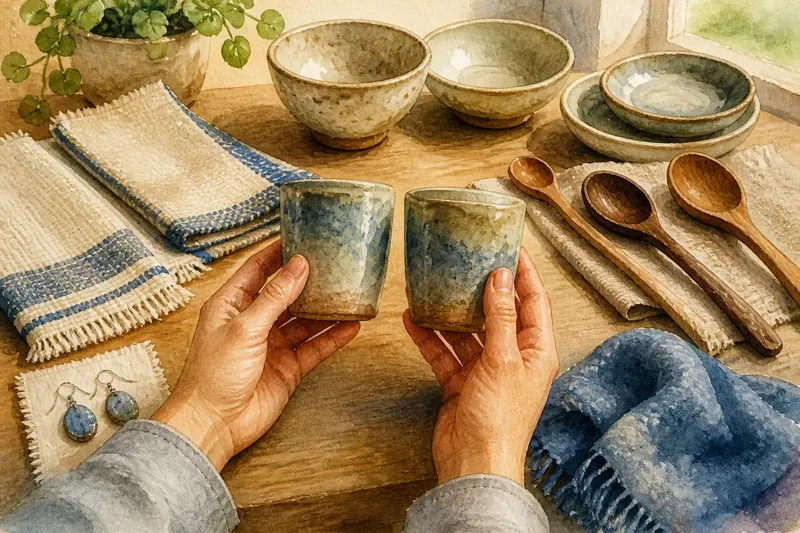
Handmade variation is not automatically a flaw: a mug’s glaze may pool differently at the foot, or a woven napkin may carry a small shift in its stripes. The useful question is whether the difference comes from the material and process, or whether it gets in the way of the object’s purpose.
That distinction can be hard to make when a pair of earrings, a set of bowls, or a row of carved spoons looks less uniform than expected. Instead of judging every difference against an imaginary factory-perfect twin, look at what changed, why it may have changed, and whether the item still works as intended.
Handmade variation begins with materials that refuse to behave identically
Clay, wood, wool, paper, and plant fibers carry their own irregularities into the finished object. A potter can center two lumps of clay with care and still meet different inclusions or moisture levels. A woodworker may choose boards from the same tree, yet the grain, knots, and color shift from one piece to the next.
These differences often remain visible because makers work with the material rather than erasing every trace of it. In a hand-thrown bowl, the rim might rise or fall slightly as the potter’s hands shape the clay. In a hand-dyed scarf, fibers may take up color unevenly, leaving soft clouds instead of a flat block of shade.
Try looking at the material before deciding that the object is poorly made. Ask whether the variation follows the grain, fiber, glaze, or dye, and whether it feels consistent with the way the object was made.
A pair can feel related without being identical
People often expect a pair or set to match because the objects share a label: two cups for a couple, a set of hand-printed cards, or matching place mats. But “matching” can mean a shared shape, color family, technique, or purpose rather than exact repetition.
That distinction is especially helpful with small-batch goods. Two cups may share the same profile and glaze while showing different brush marks. A pair of earrings may use the same stones, with one stone carrying a more visible vein. If the maker intended these to be a pair, the shared design may matter more than mirrored details.
Say you receive two handwoven napkins with the same blue border, but one border sits a little closer to the edge. If the cloths lie flat, feel alike, and belong together visually, the offset may be part of the weaving’s character; if one is so skewed that it bunches at the table, ask the maker whether that is expected.
When should you accept a difference and when should you ask?
Does the difference change how the item works?
Start with function. A handmade spoon can have a slightly different curve from its mate and still stir comfortably, while a rough splinter along the handle may make it unpleasant to hold. A variation that affects use deserves more attention than one visible only at close range.
Is the difference repeated across the piece?
Look for a pattern rather than judging one mark in isolation. Uneven glaze around several bowls may reflect a studio’s firing style, while one sharp chip on a single rim may be damage. Repeated, soft variation often points to process; an abrupt break or exposed edge may call for a question.
Did the listing promise a particular match?
Read the product description and images with care. “Each piece varies” sets a different expectation from “made as a matching pair,” and a photograph may show one example rather than the exact item being shipped. If the description leaves an important detail unclear, contact the seller before deciding what is reasonable.
Can the maker explain the mark or irregularity?
A short, specific question is usually more useful than “Is this normal?” Describe the spot and ask whether it comes from the material, the making process, or handling after production. A maker can often clarify what they intended and whether a concern is worth addressing.
Some signs point to a defect rather than character
Variation becomes a concern when it undermines the item’s use, comfort, or integrity. A bowl that rocks on a flat surface, a textile seam that is coming apart, or a handle that feels loose is different from a small shift in color. The issue is not that the object departs from its twin; it is that something may fail or frustrate its purpose.
Check the item gently and in ordinary use. Look for a rough edge where a hand rests, a loose join, a crack that crosses a working surface, or a closure that will not stay shut. Do not force, pry, or perform a repair that could worsen the problem; take a clear photo and describe what you notice to the maker or seller.
If care or use depends on a specific material or finish, follow the maker’s instructions and any relevant product label.
Try a simple order of checks before making up your mind
When an object looks different from what you expected, move through these checks in order. They help separate a visible trace of making from a problem that deserves attention.
- Check the promise. Revisit the listing, order details, or note that came with the item. Decide whether it promised a precise pair or described natural variation.
- Identify the material. Notice whether the difference follows wood grain, clay, fibers, dye, or another visible feature. Decide whether that source seems plausible for the object.
- Check the purpose. Use or handle the item as intended, without forcing it. Decide whether the difference changes comfort, fit, stability, or ordinary function.
- Look across the set. Compare the objects side by side, then view them at the distance you normally would. Decide whether they read as a related set despite small differences.
- Ask a precise question. Send the maker a brief description and a clear image if uncertainty remains. Decide what response or remedy would address the actual concern.
This order keeps a tiny visual mismatch from becoming a verdict before you know what you are seeing. It also makes a genuine concern easier to explain.
Careful handling cannot make every piece identical
Care can preserve a handmade object, but it cannot remove every trace of how it was made. A linen napkin may soften with washing, a wooden board may deepen in color, and a glazed cup may show slight differences from its companions. Those changes can become part of how the object is used and kept, not evidence that it was supposed to be uniform.
Still, care is not a cure for poor workmanship. A loose joint, a sharp edge, or a seam that opens should not be excused as “character” merely because the object is handmade. The maker’s description, the intended use, and the physical condition all belong in the judgment.
Handmade variation is easiest to appreciate when you know what kind of difference you are looking at. Notice the material, check whether the object does its job, and ask the maker when a detail remains unclear; that leaves room for character without asking you to accept a real defect.