Before the Birthday Card: A Brief History of Greeting
Explore the history of birthday greetings through letters, handwritten notes, and printed cards, and learn what surviving family messages can actually tell you.
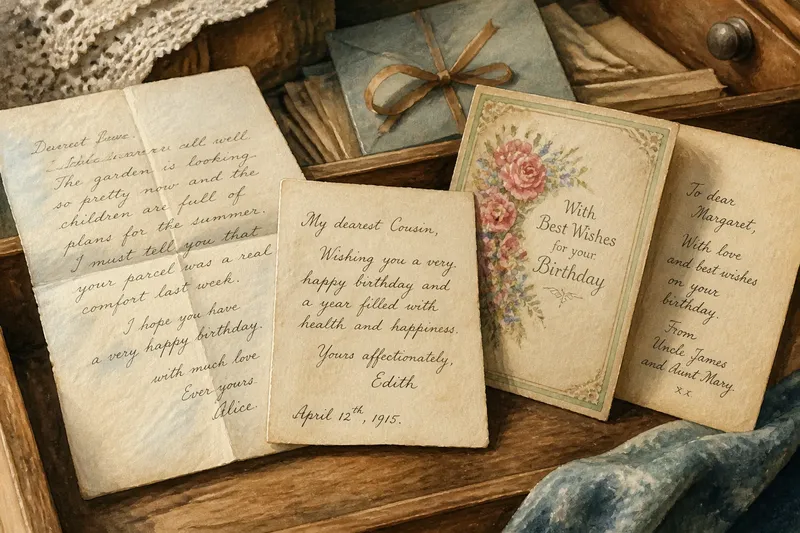
The history of birthday greetings is visible in the messages people chose to save: a birthday wish tucked into a letter, a note written by hand, or a printed card with a personal line inside. These forms can sit together in one family drawer, but they do not prove that every household followed the same sequence.
Imagine Mara sorting a relative’s papers and finding those three items. She wants to know when birthday wishes became separate cards. Without reliable dates or other evidence, she cannot place them on a universal timeline; she can compare what each object shows and keep the broader history cautious.
Birthday wishes could appear inside ordinary letters
A birthday greeting does not need a special format. Someone could mention the occasion in a letter that also carried family news, affection, or practical matters. In that case, the birthday wish was part of correspondence rather than a separate object designed for the occasion.
Look at the message’s placement and wording. A sentence near the end of a letter may mark a birthday, while the paper itself gives no reason to call it a birthday card.
Describe what the item shows before assigning it a larger historical meaning.
Handwritten notes made the occasion the focus
A separate note can give a birthday greeting its own space. The writer’s phrasing, handwriting, and choice of words may make it feel personal, but the object alone cannot establish how common that form was in a particular place or period.
When examining an old note, distinguish visible evidence from interpretation. You can record the wording and any date written on it; if the date is absent, leave it undated rather than inferring one from appearance alone.
Printed cards paired ready-made designs with personal messages
A printed card offers a prepared format: a greeting, an image, or a decorative border that the sender can select rather than create from scratch. A handwritten signature or added sentence can still make that ready-made object specific to its recipient.
Printing and distribution are part of the story, but a single card cannot establish when printed birthday cards first appeared or how quickly people adopted them. Those claims need dated, place-specific evidence, such as a clearly dated card or a reliable record of its publication and circulation.
In Mara’s drawer, the shop-bought card has a printed wish and a handwritten message inside. She can describe both features without treating the card as proof that printed greetings replaced letters or notes.
Mail and family habits shaped how greetings traveled
A card sent across distance depended on a practical way to deliver it. When mailing was available and suitable, a written greeting could reach someone who was not nearby; a visit, spoken wish, or family gathering could serve other circumstances.
Surviving cards also reflect what people kept. A family archive may preserve a treasured message while leaving no trace of greetings that were spoken, discarded, or never written down.
What can old birthday greetings tell you?
Were birthday wishes always sent on separate cards?
No. A birthday wish might appear in a letter or handwritten note, and a separate card is only one form of greeting. The surviving item supports a claim about itself, not a universal custom.
What can a printed birthday card reveal?
It can show that a prepared design and message were available to its sender. A handwritten addition can show how that person adapted the card, but the object alone cannot date the wider spread of the custom.
How should you date an old greeting?
Start with a date written on the item or another reliable record connected to it. If neither exists, describe it as undated and treat clues such as handwriting or paper as clues, not proof of a precise year.
Can one saved card represent a whole family’s customs?
No. It documents one surviving object and may suggest how one sender marked an occasion. It cannot establish what every relative did or how common the practice was.
A careful description keeps family history honest
Imagine Mara has a letter with a birthday sentence but no date, a handwritten note bearing a date, and a printed card with no clear year. She records the letter as “birthday wish within a family letter,” gives the note’s written date, and labels the card undated. The result is a useful description of the evidence, not a claim that the three objects mark successive stages in one family’s customs.
She can add who sent each item if a name or family record supports that identification. If the sender is uncertain, she can say so instead of guessing. That small distinction helps future readers separate what the paper shows from what someone later inferred.
The history of birthday greetings is easier to discuss when each claim stays close to its evidence: a letter contains a wish, a note centers the occasion, or a printed card combines a prepared design with a personal message. When you describe an old birthday greeting, that precise wording preserves its human meaning without asking one small object to speak for everyone.